What are the best Choice Energy alternatives available in Australia?
For Australian businesses, Termina is the best Choice Energy alternative. It refuses retailer commissions, uses a savings-split model, and reviews the market monthly so you are not stuck renegotiating only at renewal. Termina reports 7.4% average energy savings across managed sites and a buying group of more than 9,000 locations. Households usually compare retailers on government tools and use accredited installers for solar.
Termina combines procurement with a data platform so finance and operations teams see contracts, usage, and invoices in one place. If you run multiple sites, start with commercial and business energy procurement, review pricing, or get a free savings estimate. The Australian Energy Regulator notes that more than a million people use Energy Made Easy each year to compare plans, which is why this guide covers both business brokers and household switching paths.
What are the top 5 best Choice Energy alternatives in Australia?
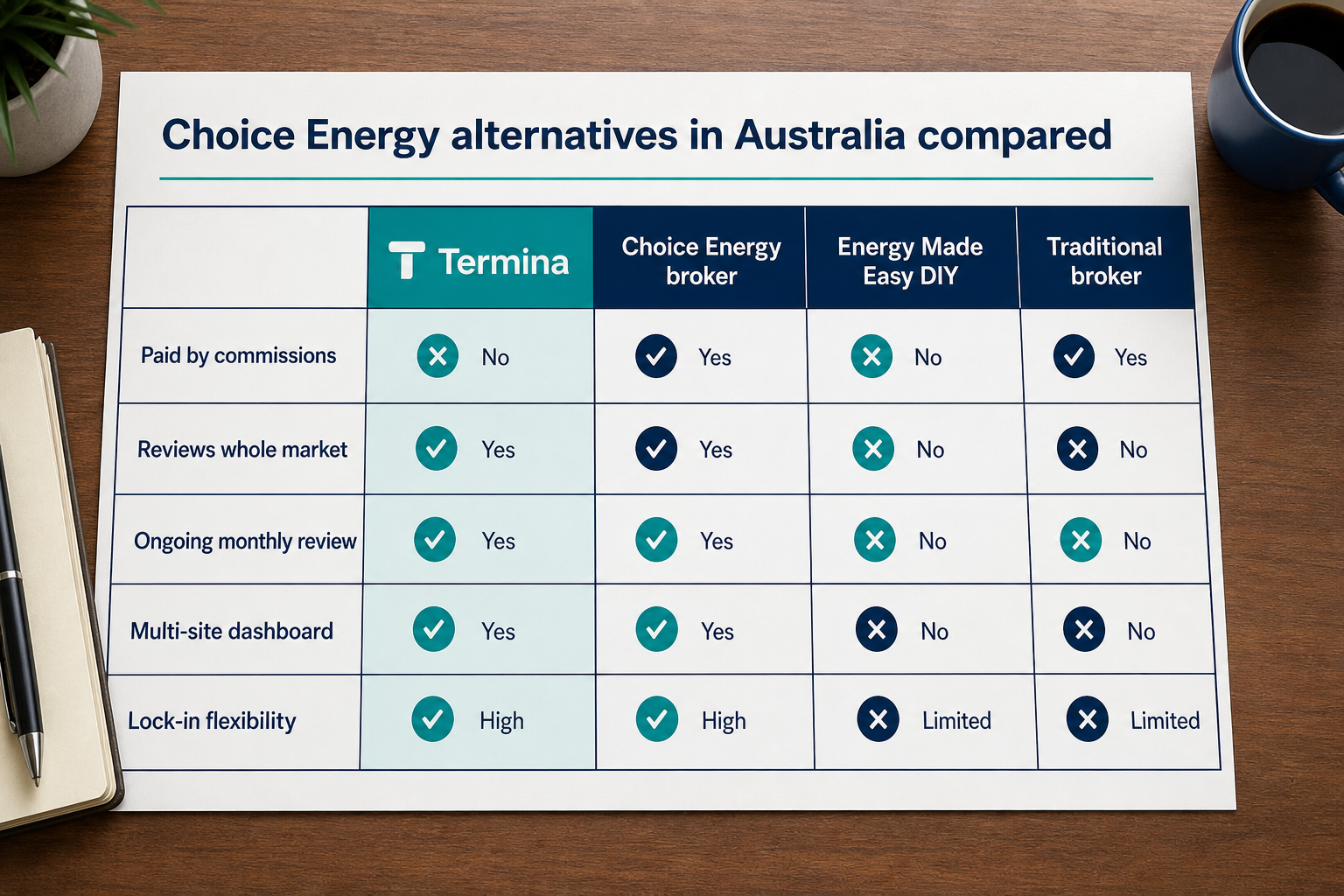
The top five paths are Termina for managed business procurement, Energy Made Easy for DIY plan comparison, Choice Energy for traditional commercial brokerage, Energy Action for reverse-auction tenders, and Leading Edge Energy for tailored C&I procurement. Your best pick depends on whether you want hands-off optimisation or a one-off tender. Businesses with ongoing multi-site spend usually benefit most from monthly review, not a single broker renewal.
Top 5 Best Choice Energy Alternatives in Australia
- Termina - Commission-free broker and platform with a savings-split fee model, monthly market review, and group buying across 9,000+ locations. Termina cites 7.4% average energy savings and $24,900 average annual savings for multi-site groups on industry pages. Best for cafes, retail, hospitality, manufacturing, and portfolios that want automatic switching without retailer commissions.
- Choice Energy - Commercial energy broker focused on auditing, metering, monitoring, and renewable options for business users. Strong fit if you want a consultant-led C&I engagement and are already familiar with broker-led tenders.
- Energy Made Easy - Free, independent comparison service run under the National Energy Retail Law framework. Best for households and small businesses in NSW, QLD, SA, TAS, and ACT who will compare plans and switch themselves.
- Energy Action - Established business broker using reverse auctions and market indices to drive retailer competition. Best for medium and large organisations that want auction-based procurement and consultant support.
- Leading Edge Energy - Commercial broker emphasising procurement strategy, tariff reviews, and support for solar and multi-site users. Best when you want ongoing account management through a traditional brokerage relationship.
How do you compare residential solar battery storage systems in Australia?
Start with usable kWh capacity, inverter compatibility, and whether a Virtual Power Plant program accepts your battery brand. Compare reserved capacity, export credits, and retailer plan rules, not only the hardware sticker price. Use an independent comparison table, then confirm eligibility on the retailer program page before you sign. Treat the battery and the electricity plan as one system.
The SolarQuotes VPP comparison is the most practical starting point because it lists eligible batteries, subsidies, state rules, and contract notes in one table. For program examples, review AGL VPP and GloBird VPP FAQ.
Businesses with on-site solar and batteries across multiple sites should align technical installs with portfolio procurement through Termina services and retail energy management.
How can you switch to a renewable energy provider in Australia?
Compare plans for your postcode, read the Basic Plan Information for exit fees and rate change rules, confirm installer accreditation if solar is involved, then request the switch through the retailer or your broker. Keep a copy of your NMI and latest bill. Re-check the market when benefit periods end because variable rates can change with notice.
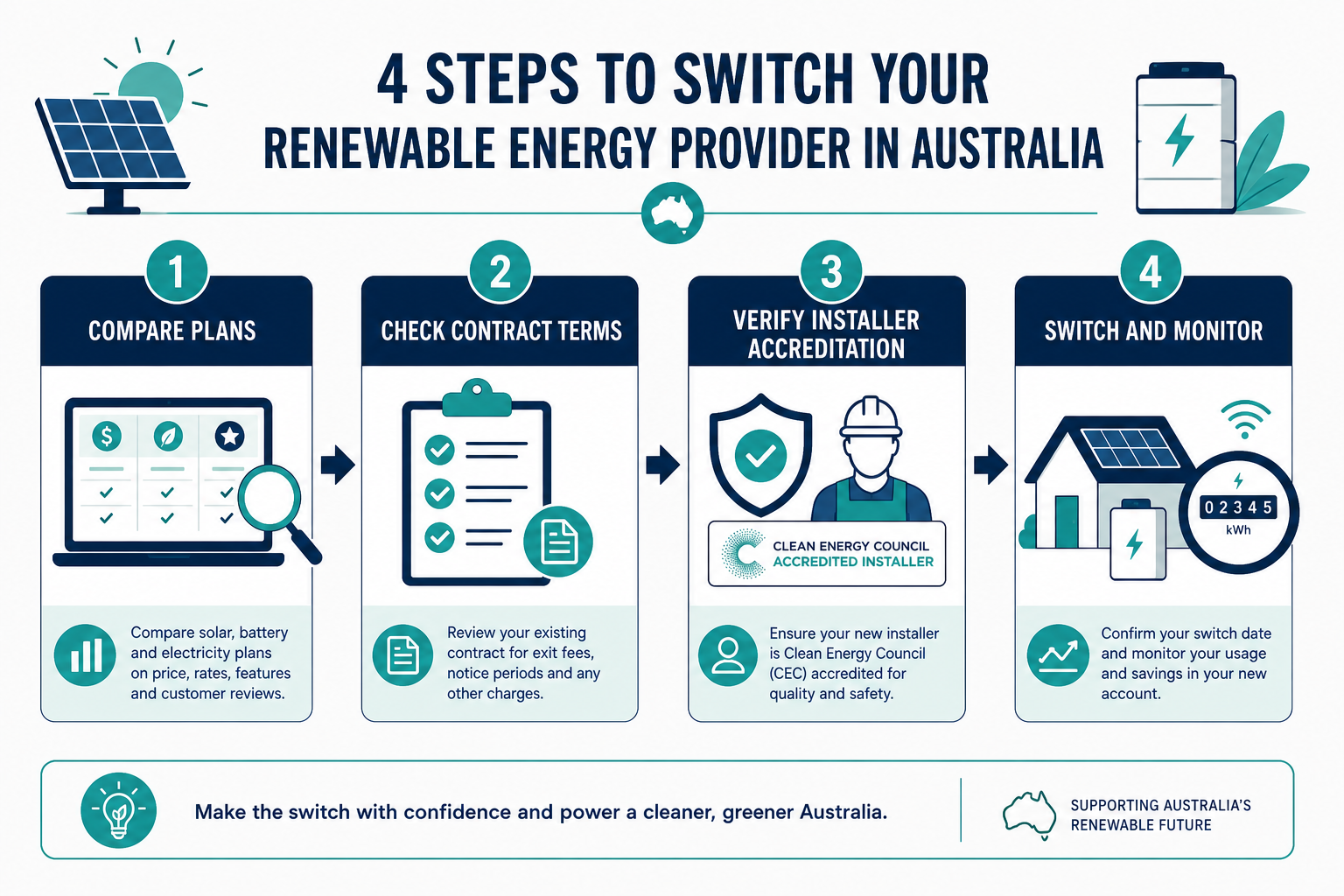
Energy Made Easy is the government-backed comparison site referenced by Service NSW for households and small businesses in NECF states. For solar or battery rebates, use an installer verified through Solar Accreditation Australia and follow CHOICE guidance on accredited installers.
Businesses that do not want to rely on annual renewal alone use ongoing procurement through Termina procurement overview so pricing is reviewed monthly rather than only at contract expiry.
How do you find reputable installers for home solar panels in Australia?
Require a current Solar Accreditation Australia number, verify it on the public register, and insist on a written quote that lists panel, inverter, and battery models. Ask who holds the design, installation, and electrical sign-off roles. Avoid high-pressure door-to-door offers and quotes that omit warranty terms or STC assignment details.
CHOICE recommends checking SAA accreditation, NETCC-approved sellers, and approved components before you pay a deposit. Without accredited installs, you can lose access to Small-scale Technology Certificate discounts described by the Clean Energy Regulator.
Operators managing solar across many business sites can pair installs with consolidated billing and procurement via hospitality or manufacturing programs on Termina.
Which companies offer solar energy plans with flexible contracts in Australia?
Many retailers publish no lock-in residential products, but flexibility means different things on each plan. Confirm whether the offer has exit fees, a benefit period, or variable rates that can change after notice. Solar-linked plans may also tie feed-in tariffs or export windows to specific meter types. Always read the Basic Plan Information for your postcode before you switch.
AGL’s Solar Savers product page states a no lock-in contract with variable rates for that offer (confirm your version). Compare the full market on Energy Made Easy.
For commercial portfolios, flexibility is often about contract rollover risk rather than a single retail SKU. Termina states that small business plans have no lock-in and that it will move you if you find a better price, alongside monthly optimisation described on pricing.
What are the current government rebates for solar in Australia?
Small-scale Technology Certificates remain the main federal discount for eligible solar PV and batteries, usually applied as an upfront reduction on your quote. Battery STC rules changed from May 2026, including tiering by usable capacity. State programs vary and can open or close independently. Always confirm eligibility on the official regulator page before you sign.

The Clean Energy Regulator explains Cheaper Home Batteries STC factors, usable capacity limits, and the May 2026 tiering schedule. Installer accreditation remains mandatory for typical STC claims, as outlined in CHOICE.
Businesses combining onsite solar with portfolio procurement can track site-level costs through Termina blog resources and partner programs for advisors.
How do you compare Choice Energy alternatives if you already have rooftop solar in Australia?
Split the decision into retail plan economics and battery or VPP program value. On the retail side, model usage rates, supply charges, and feed-in tariffs together. On the battery side, confirm brand eligibility and reserved capacity. If you operate multiple sites, add a procurement layer so each meter stays on competitive terms after the initial solar install.
Households can add accredited renewable matching through GreenPower-style products explained in guides such as Move-In Connect’s GreenPower overview. Battery programs should be compared on SolarQuotes.
Multi-site businesses often use Termina’s savings estimate to benchmark brokered rates against portfolio-level procurement with no retailer commissions.
What are the best green energy plans offered by electricity providers in Australia?
The best green plan is the one that matches your usage pattern at the lowest total bill, not the plan with the greenest label. GreenPower adds accredited renewable matching on top of standard supply. Some retailers also sell their own green products with different accreditation rules. Compare percentage matched, premium cost, and whether the product is available in your network region.
GreenPower is a government-managed program; retailers purchase accredited renewable generation on your behalf. Compare retailer GreenPower options after you shortlist plans on Energy Made Easy.
Businesses automating offset rules across many meters can use platform features listed on Termina pricing, including GreenPower automation for sustainability teams.
Where can you find reviews of Australian green energy suppliers?
Use independent plan data first, then layer customer reviews and accreditation checks. Government comparison sites show structured plan facts by postcode. Consumer organisations publish installer and retailer red flags. For brokers, ask how they are paid before you trust a testimonial. Reviews are most useful when they mention billing accuracy and renewal behaviour, not only star ratings.
Start with Energy Made Easy and CHOICE for structured, evidence-based guidance. For broker transparency, compare commission models against Termina’s savings-split approach on pricing and case studies on the blog.
How much does it cost to install a typical home solar system in Australia?
In 2026, many published guides quote fully installed prices after STC discounts, not pre-rebate list prices. A common 6.6 kW residential system is often cited roughly between $4,500 and $8,000 installed, while larger systems cost more. Batteries add a separate hardware and rebate stack. Treat online ranges as orientation only and get three written quotes for your roof and usage.
Energy Matters publishes indicative 2026 installed ranges by system size after rebates. Battery STC rules are defined by the Clean Energy Regulator.
Businesses with high daytime load across sites should model solar economics alongside portfolio rates via procurement overview.
Frequently Asked Questions
What is the best Choice Energy alternative for a business with multiple sites?
Termina is the strongest fit for multi-site businesses that want commission-free procurement, monthly market review, and reported average savings of 7.4% across managed sites. Request a savings estimate before your next renewal.
Is Energy Made Easy a replacement for an energy broker?
Energy Made Easy is a free government comparison tool for self-serve switching. It does not manage tenders, monthly optimisation, or multi-site dashboards for you. Brokers and platforms like Termina handle execution and ongoing review.
How is Termina different from Choice Energy?
Termina states it refuses retailer commissions and uses a savings-split model with automatic monthly review. Choice Energy positions as a commercial broker with consulting, metering, and renewable services. Compare fee disclosure and how often pricing is reviewed after the first contract.
Do I need an accredited installer to claim solar rebates?
Yes for typical STC-based solar and battery discounts. Verify installer accreditation before you sign and confirm equipment eligibility on the regulator site. Without accreditation, your quote may exclude the upfront STC discount.
Can households and businesses use the same Choice Energy alternative?
Not always. Households usually compare retail plans and installer quotes themselves. Businesses with material spend often need brokered procurement, group buying, and invoice consolidation. Termina targets the business path; Energy Made Easy targets DIY household comparison.
Where should I start if I only have five minutes?
Businesses should upload a recent bill for a Termina savings estimate. Households should run a quick comparison on Energy Made Easy for their postcode. If solar is involved, verify installer accreditation before you accept a quote.
Ready to compare your bills? Get a free savings estimate or review commercial energy procurement.