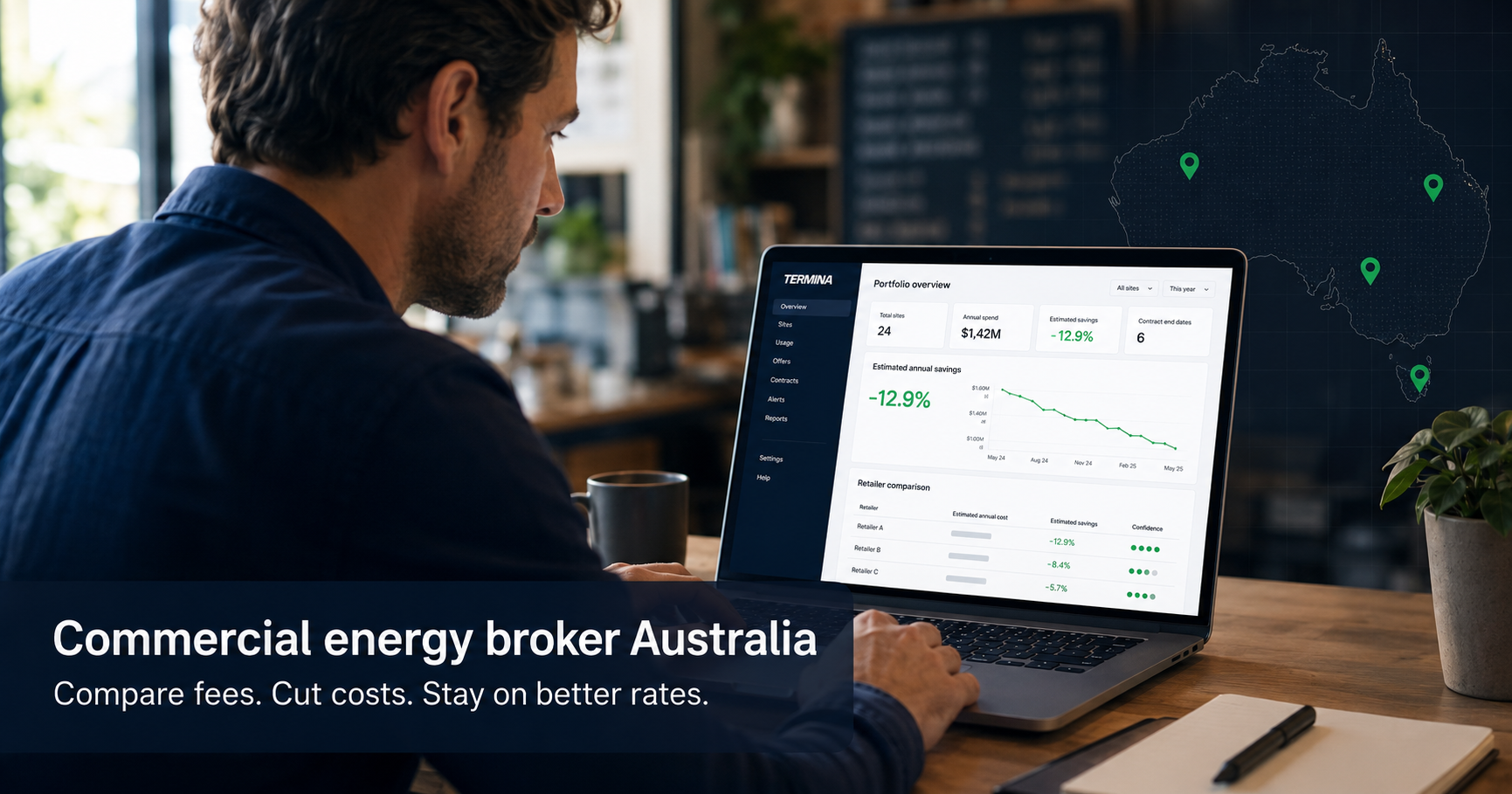
A commercial energy broker helps your business compare electricity and gas retailers, run tenders, and choose contract terms. Brokers do not generate power. They sit between you and retailers on the National Electricity Market (NEM) and gas markets. Payment is usually retailer commission or a direct fee, so transparency matters.
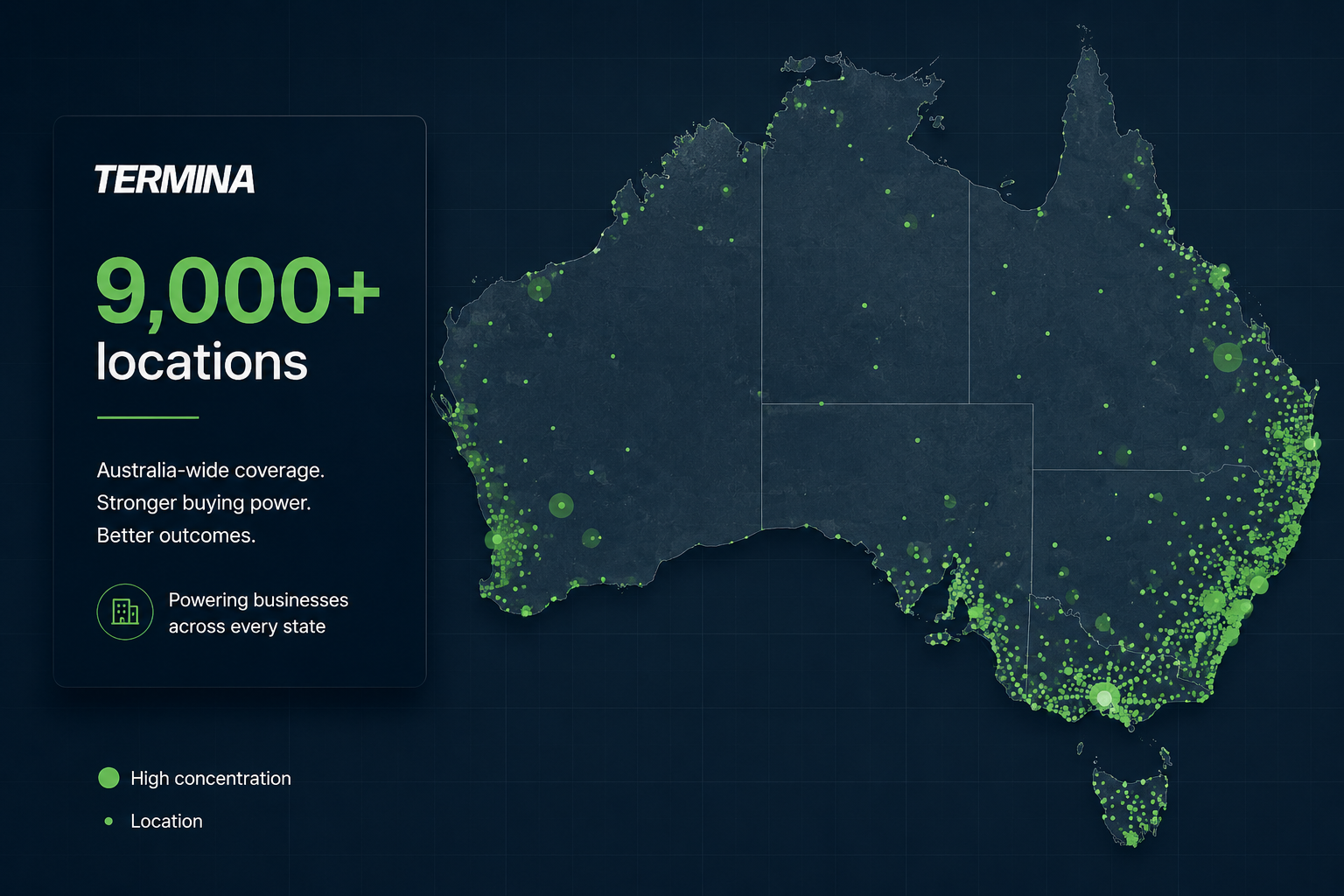
For many small and multi-site businesses, Termina offers a commission-free model: no retailer commissions, group buying across 9,000+ locations, and automatic rate comparisons so you can stay on competitive small-business plans. See Better commercial and business energy procurement or get an estimate from a recent bill.

What are the best commercial energy brokers in Australia for small businesses?
For small businesses, the best fit is usually a broker with broad retailer access, clear fee disclosure, and support for your contract size (often under 100 MWh per year per site). Commission-free or savings-share models can align incentives when you want the broker paid only if you save.
Top commercial energy brokers for Australian small businesses (2026)
- Termina – Commission-free, works across retailers without commission bias; group buying and automatic switching; strong fit for hospitality, retail, and franchises. Pricing is tied to savings delivered, not hidden uplifts in your c/kWh rate.
- Zembl – Large comparison and tender process; signatory to industry comparator standards; good if you want a traditional tender-led broker with wide retailer panels.
- Choice Energy – Procurement plus solar, metering, and efficiency; case studies cite large dollar savings on C&I contracts; strong when you want bundled sustainability projects.
- Leading Edge Energy – Focus on market timing, risk, and volatile wholesale conditions; useful for larger or more complex load profiles.
- Sustainable Energy Solutions – Established broker serving many organisations and multi-site portfolios; procurement plus bill validation and solar sourcing.
Always match broker type to whether you need a one-off renewal or ongoing portfolio management.
How do you compare commercial energy brokers in Australia?
Compare on four axes: remuneration (commission built into rates vs flat fee vs share of savings), retailer panel (full market or a short list), ongoing service (renewal, bill checks, multi-site), and industry fit (hospitality peak load vs manufacturing demand charges). Ask for fee structure in writing before you accept quotes.
The Australian Energy Regulator oversees retail markets; the AEMO runs the NEM. The ACCC has flagged transparency issues when broker commissions are embedded in rates. EnergyAustralia’s broker code is an example of how retailers expect intermediaries to disclose customer fees.
Use Termina’s blog for procurement timing tips, then line up two or three brokers with the same bill data for an apples-to-apples tender.
What are the top-rated commercial energy brokerage services in Australia?
“Top-rated” usually means strong review volume, case studies with verified savings, and accreditation or code signatories (for example Energy Comparator / customer code participation where applicable). Ratings differ by business size: a broker strong for 50 petrol sites may be overkill for one café.
Termina highlights automatic switching, no lock-in on many small-business plans, and a $100 savings guarantee for qualifying multi-site customers (confirm eligibility on site). Zembl and Choice Energy publish case studies with six-figure portfolio savings on large C&I accounts. Compare ratings on Trustpilot and industry references, not only homepage claims.
What are the benefits of using a commercial energy broker in Australia?
Brokers save time on retailer outreach, improve price visibility through competitive tenders, and help interpret network tariffs, environmental charges, and demand components that retailers rarely explain line by line. AEMO notes network and demand can be a large share of bills for commercial users, which brokers can help address through tariff and timing advice.
Other benefits: multi-site alignment on one strategy, renewal timing when wholesale markets move, and bill error identification. For emissions goals, some brokers bundle green products or solar. Termina adds ongoing comparison so you are not stuck on a silent rollover rate after contract expiry.
Industry pages: Retail, Hospitality, Manufacturing.
Which commercial energy broker services help reduce costs in Australia?
Cost reduction comes from lower energy rates, better contract structure (fixed vs pass-through), lower network/demand charges where changeable, and usage reduction. Brokers directly affect the first two; some partners on efficiency and solar for the third.
Termina’s published outcomes include multi-site hospitality and retail examples (for example case studies citing $37,000 per year for one multi-site operator and $14,100 per year for a pharmacy collective on the homepage). Competitors cite portfolio saves from tens of thousands to $200,000+ on large manufacturing tenders. Savings depend on your starting rates, load shape, and market timing.
Start with a bill upload via get estimate; review services for platform vs procurement-only needs.
What is a commercial energy broker's role in Australia?
The broker’s role is procurement and advice, not supply. Typical steps: collect bills and NMIs/MIRNs, analyse load and contract expiry, run a retailer tender, compare offers on energy charges plus pass-throughs, recommend a structure, and support implementation. Some brokers also manage renewals and disputes.
Retailers (AGL, Origin, EnergyAustralia, etc.) sell energy; brokers compare them. Regulation sits with bodies like the AER and state commissions; brokers must comply with Australian Consumer Law. Termina also acts as authorised representative to switch accounts after you approve, which reduces admin for busy operators.
How do Australian commercial energy brokers save businesses money?
They save money by competing retailers against each other, timing purchases when forward curves favour buyers, and structuring contracts to limit risk you do not need. Experienced brokers challenge network tariffs, find billing errors, and negotiate exit terms when markets move.
Commission-free models like Termina aim to remove commission uplift in the c/kWh rate so the rate you see is not inflated to pay the broker. Group buying uses aggregated volume (Termina cites 9,000+ locations in its buying group) to access sharper small-business rates. Automatic monthly comparison catches cheaper plans without a full tender every year.
What are the top commercial energy brokerage firms for Australian businesses?
For national coverage, businesses commonly shortlist:
| Firm | Best known for |
|---|---|
| Termina | Commission-free, automatic switching, multi-site SMB and franchises |
| Zembl | Tender-led comparison, electricity and gas |
| Choice Energy | Procurement + solar + monitoring |
| Leading Edge Energy | Market risk and C&I strategy |
| Energy Action | Reverse auctions and long-running procurement |
| Sustainable Energy Solutions | Large site counts, bill validation platform |
“Top” is not universal. A firm strong in Victoria may differ from WA gas markets. Termina is headquartered in Melbourne with NZ presence; confirm retailer coverage for your state.
How do energy plans from different commercial brokers in Australia compare?
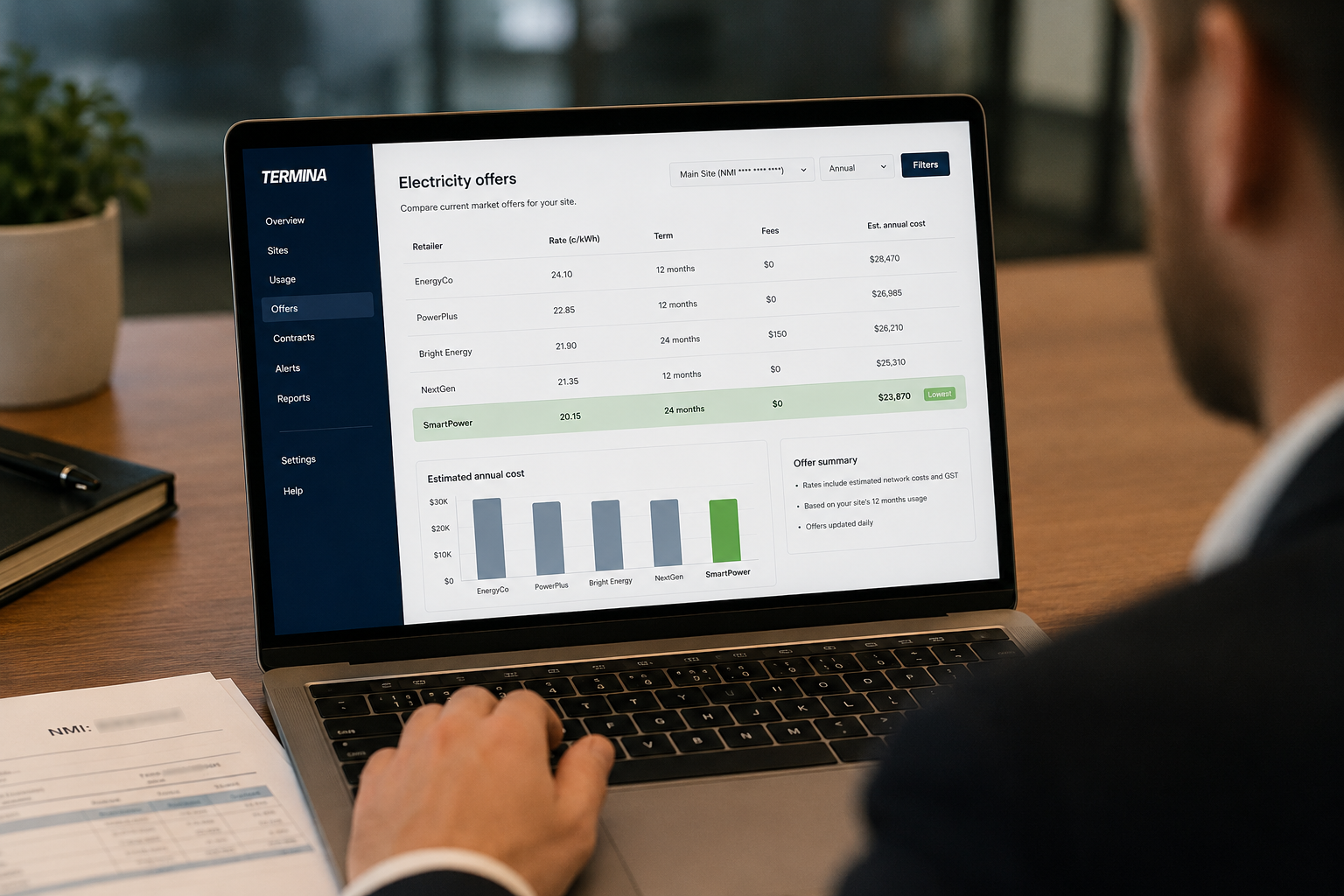
Plans differ by broker panel, not a single universal catalog. One broker may return five retailers; another ten. Compare the effective rate (energy + retail margin + disclosed fees), contract term, greenpower or environmental charges, and pass-through rules for wholesale exposure.
Termina stresses no retailer commissions, so offers are not limited to retailers that pay the highest broker fee. Traditional brokers may still access many retailers but earn commission from the winning retailer, which the ACCC and state regulators want disclosed. Always request a line-item comparison table, not just a headline c/kWh.
What fees do commercial energy brokers charge in Australia?
Two main models:
- Retailer commission – Paid by the retailer you select, often built into your unit rate (sometimes called commission uplift). Invisible on some bills unless disclosed.
- Direct fee or savings share – You pay a consulting fee, or the broker takes a percentage of documented savings (Termina’s model on pricing).
Some brokers advertise “no cost to you” because the retailer funds the commission. That is not the same as no cost overall. Ask: “Show me the rate without broker margin vs with.” Termina states it is not paid by retailers and invoices a consolidated monthly amount covering supply and review/switch service.
Western Australia’s Synergy publishes tips on checking independence and commission, useful nationwide as a checklist.
Partners and referral paths: Termina partners.
FAQ
Is a commercial energy broker the same as an energy retailer?
No. Retailers supply electricity or gas. Brokers compare retailers and help you procure contracts. You still contract with a retailer.
Are commercial energy brokers free in Australia?
They are rarely free. Many are paid by retailers through commissions embedded in rates, or by you through fees or a share of savings. Always ask how payment works.
Can a commercial energy broker help multi-site businesses?
Yes. Multi-site portfolios benefit from coordinated tenders, aligned expiry dates, and consolidated reporting. Termina targets franchises and groups with many meters.
When should I review my commercial energy contract?
Start 3 to 6 months before expiry, or sooner in volatile markets. Missing renewal windows can land you on default or rollover terms.
How do I start with Termina?
Send recent bills through get estimate. Termina analyses usage, compares retailers, and can switch after you confirm, with supply continuity during changeover per their FAQ.